
Delaware-incorporated and San Francisco-based Anthropic PBC, one of the leading global frontier AI labs, publicly filed its much-anticipated Form S-1 Registration Statement with the SEC on 26 October 2026 – ahead of its equally much-anticipated IPO, currently expected for mid-November 2026. On 2 November 2026, it filed an amended S-1/A, which, among other updates, provided further financial information.
Alongside its ticker (ANT), we learned much about Anthropic via this initial public filing, including its governance and internal structure, financial statements and schedules, and self-reported risk assessments. Given the current and future importance of AI development to the domestic US and global economy, as well as its ongoing impact on liquid and private financial markets (particularly equities and credit), we were happy to glean some insights – at once encouraging and concerning – into the economics of AI. This is as Anthropic and its rival OpenAI Group PBC embark on the most ambitious J-curves in the history of business.
Here are our top 5 takeaways, from most reassuring to most concerning.
At first glance, frontier AI can be a profitable business
One of the biggest (positive) surprises from the filing was surely the swing to operating profitability for Anthropic over the first nine months of 2026. The firm reported adjusted operating income of $4.08b over the period, against revenue of $33.24b – implying an adjusted operating margin of 12% (p. 158 [A]). This is thanks to two consecutive quarters of positive adjusted operating income (Q2/Q3 2026). Importantly, this adjusted (non-GAAP) measure of operating income excludes the impact of certain non-cash and non-operating expenses, such as stock-based compensation (SBC), or changes in the fair value of convertible notes, derivative liabilities and SAFEs – among others.
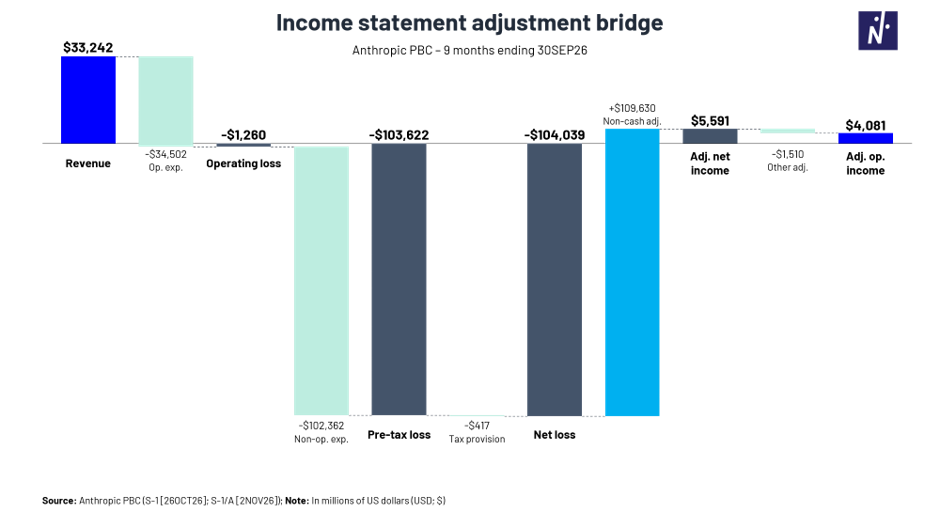
Excluding such line items does not appear unreasonable, given they have no direct bearing on the operating economics of the firm. In fact, away from the income statement, we also see positive operating cash flow from the business over the same period, coming in at $6.57b (p. F-12 [A]). As a reminder, operating cash flow removes further non-cash expenses, such as changes in the fair value of mark-to-market financial instruments, D&A, or any positive changes in working capital. Even adjusted net income is reported as positive, coming in at $5.59b (p. 159 [A]).
We will note these adjusted or cash measures stand in stark contrast with (unaudited) GAAP line items for the first nine months of 2026 (pp. 149, F-7 [A]) – which include an operating loss of -$1.26b and a staggering net loss of -$104.04b. The biggest contributors to the differential between GAAP and adjusted measures include the aforementioned: changes in the fair value of convertible notes (a massive -$94.32b), changes in the fair value of mark-to-market financial instruments (a material -$10.28b), and SBC (-$3.25b).
Again, the adjustments made in the filing to reflect “true” operating profitability are not unreasonable – and so Anthropic did achieve it, probably making it the first frontier AI lab to do so. The implications are quite significant: it could be the first empirical proof that frontier AI business models can be sustainable – threading the needle between AI demand growth and acquisition, training and inference computing costs, and appropriate customer pricing/billing. That said, we are effectively talking of two profitable quarters. As we will see below, the headline numbers may not indicate long-term business model sustainability.
Equity financing has been generous – resulting in huge cash war chests
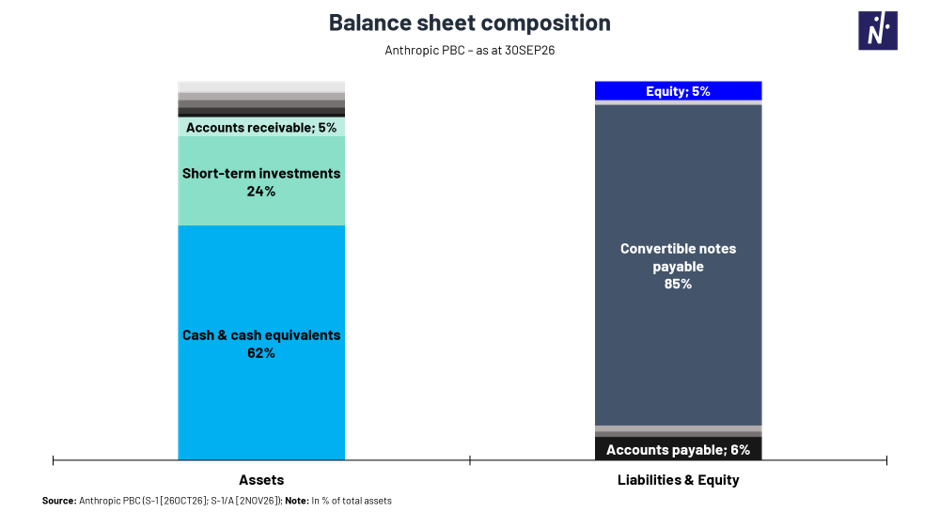
The other piece of good news from the S-1 filing was undoubtedly Anthropic’s large cash balances. The firm has essentially managed to hold on to most of the ~$140b in cash it has raised since early 2024. As of 30 September 2026, cash reserves stand at $98.10b, or 64% of total assets – if one includes cash, cash equivalents, and restricted cash (2%). Furthermore, if one includes its holdings of short-term investments (mostly US Treasury debt securities and money market funds), the total rises to $134.38b, or ~87% of its balance sheet.
The interest income which Anthropic generates from these holdings alone would be enough to make many Fortune 500 CFOs envious. In the nine months ending 30 September 2026, the firm generated $2.36b in investment income from its treasury. Overall, the balance sheet as reported is quite healthy. As the firm rarely capitalizes expenses, preferring leasing, it maintains an asset-light model. Furthermore, the leases it has capitalized so far do not represent a huge portion of its balance sheet – though this is likely to change imminently (more on this below).
On the liability-side, its main obligations include – for now – convertible notes payable of $130.5b (85% of total assets): debt-like financing which will mostly convert to equity upon achievement of the conversion trigger (i.e. Anthropic’s IPO). Were they converted as of the last reporting date in the S-1/A, liabilities and equity would represent around 10% and 90% of total assets respectively.
Cosmetically, therefore, there is nothing concerning about Anthropic’s balance sheet, and its immense cash reserves represent a “war chest” that it can leverage to scale the business in the coming months and years. The cash balances are also the symptom of a broad investor willingness, so far, to finance the AI buildout via equity and credit. However, recent market and electoral jitters around AI lab, hyperscaler, cloud, chip, and data center financing may now constrain this willingness. Anthropic’s IPO thus comes at a critical juncture for the company and the industry.
AI spend growth is currently slowing, and demand is a battle not yet won
Turning to slightly more concerning considerations: with operating profitability proven under certain conditions, and armed with ample cash reserves, how can Anthropic scale its top-line? For reasons we will see below, it is imperative that the firm (and the AI industry in general, esp. frontier AI labs) continue to deliver high, sustained, and exogenous (i.e. non-circular) revenue growth into the next few years. Against this goal stand “4 Cs” which may derail it: consumption, competition, concentration, and circularity. Let us address each in turn.
On consumption: in its amended S-1, Anthropic confirmed press reports about its Q3 2026 figures, i.e. that revenue growth had decelerated from 132% and 144% q/q in Q1 and Q2 2026, to “just” 47% q/q. Granted, the y/y sales growth figure is still a ~13x jump between the first nine months of 2026 vs. the first nine months of 2025. In fact, there have been “sputters” in the firm’s revenue growth before (such as in Q4 2025).
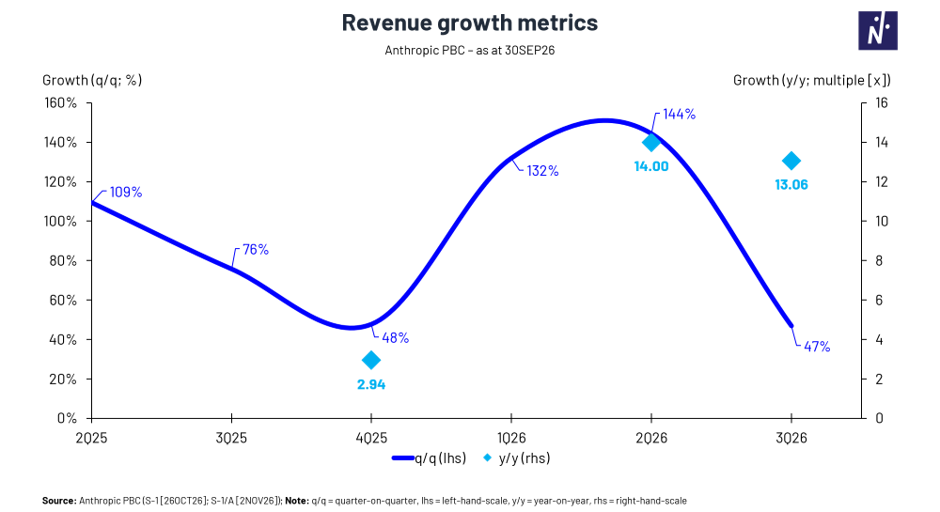
This variance reflects overall AI consumption dynamics. The lovingly-named “tokenmaxxxing” era, which began in early 2026, seems to have ended around mid-2026 – with enterprises on a push to rationalize their AI spend since. As per data provided by Ramp (an AI spend manager and router), this shows up in the adoption “S-curves” for frontier AI (incl. Anthropic), which appear to be flattening somewhat. Furthermore, overall AI spend growth seems to be stagnating, as higher token volumes are offset by much-lower token pricing. Despite this, overall Anthropic-directed AI spend appears to be staging a modest recovery in Q4 2026 so far – due to, again, higher Anthropic token volumes more than offsetting lower Anthropic token prices. (We investigate this phenomenon of lower token pricing further below.)
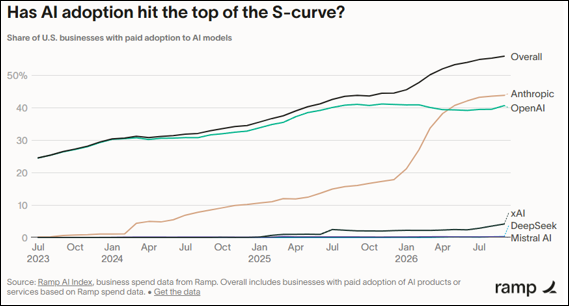
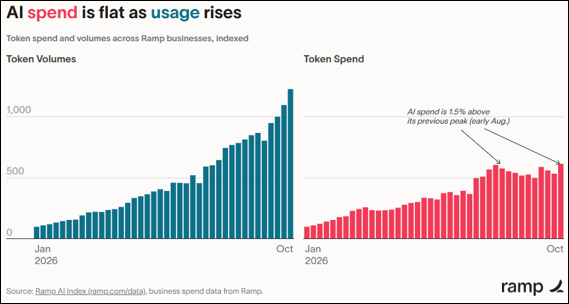
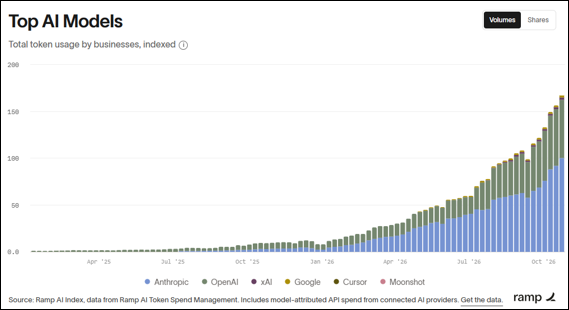
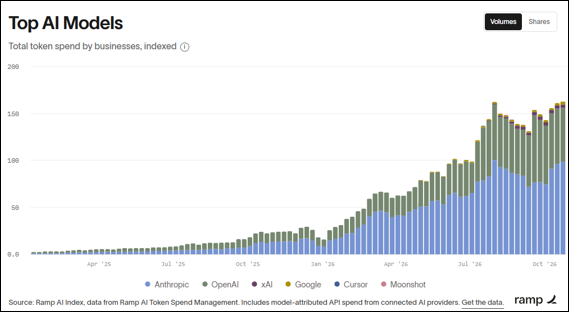
Should AI consumption patterns stagnate overall (as Ramp data suggest might be the case for total effective spend), frontier AI labs such as Anthropic would have to rely on fighting for market share with rivals – resulting in further pricing pressure.
This brings us to competition. Data from Vercel (which also operates an AI spend manager and router) suggest that the main competitors of frontier AI labs for enterprise AI spend are “open-weight” models – structurally cheaper to run, and provided by a wider set of non-frontier AI labs (often non-US-based). Of Vercel-routed queries in September 2026, 71.5% were now directed to open-weight models, as opposed to only 7% in December 2025. Open-weight models now also represent slightly less than a quarter of all AI spend tracked by Vercel, compared to only 4% in December 2025.
Again, cross-referencing against Ramp data confirms our earlier observations: both overall and frontier AI spend is flat to slightly up over the past few months, while token volumes are higher across the board. Where competition shows up, however, is not only in the relative shares of frontier vs. open-weight models, but also in token pricing. Here again, Ramp and Vercel data agree: average token pricing has roughly halved since end-2025.
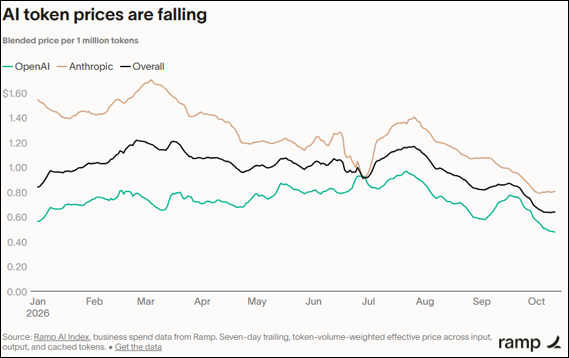
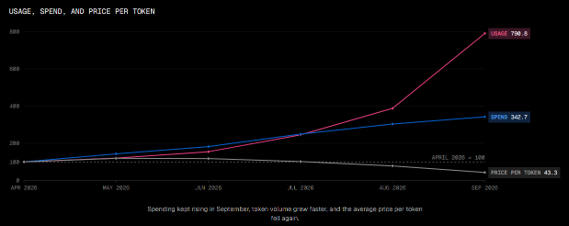
This suggests two potential explanations: (1) competitive pricing pressure from open-weight models on frontier AI models, and potentially between frontier AI models; and/or (2) greater operating efficiency in processing tokens for customers (inference), resulting from a blend of structurally-cheaper open-weight models and operating improvements for frontier models. While we will dig deeper into the merits of the second explanation below, suffice to say that competitive pressure on token pricing, combined with a lower relative share of growing token volumes, may developed into a strong headwind for frontier AI labs, including Anthropic. Vercel data further suggest we are potentially dealing with customers with high price elasticity and low lab or model loyalty. While reliance on the frontier of AI might be non-negotiable for a certain category of enterprise customers, this is not necessarily the case for all customers.
Speaking of customers, let us pivot to our third concern, i.e. concentration. Anthropic specifically addresses this topic in several portions of its S-1 filing (pp. 8–9, 57, 135–6, 144, 153, 185, F-15–16 [A]), notably pointing out that the top 5 of its 40m+ customers accounted for 25% of revenue in the first nine months of 2026. While this is an improvement from a “snapshot” of 36% throughout Q1 2026, the 2m+ ratio between these customers’ share of sales and share of population count is concerning. In a disclosure of individual customers representing either a source of revenue, or an accounts receivable credit risk, above a 10% concentration threshold, the firm routinely identified 5 customers (codenamed “A”, “B”, “C”, “D”, and “E”), which broke the threshold at one time or another over the last four years. As per the first nine months of 2026, no single customer exceeds this threshold as a revenue source – though we may presume most, if not all, of the unidentified counterparties comprise the top 5.
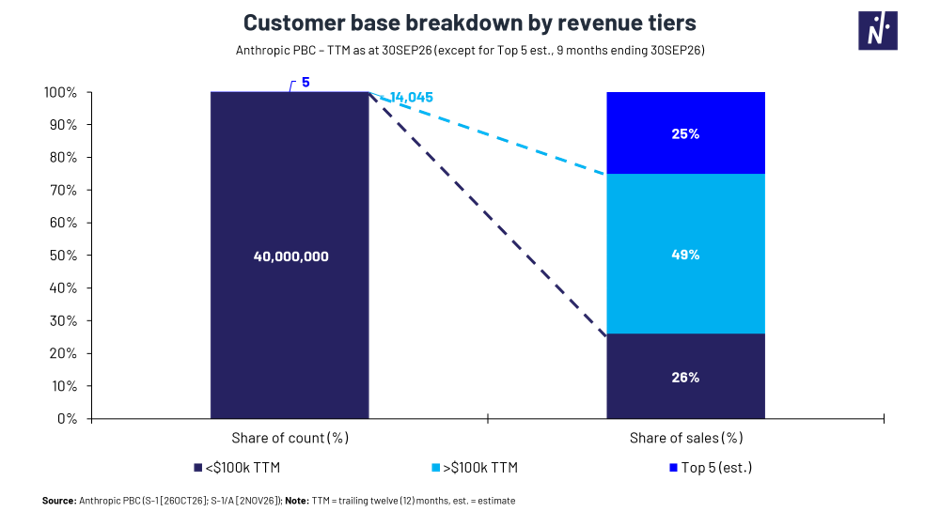
Anthropic itself correctly notes that its best pathway for continued sales growth is to both broaden and deepen adoption/monetization of its models, equally in the “long tail” of less-AI-intensive enterprise customers, as well as in the broader economy. This, however, will depend on the firm’s capacity to convince customers of its value proposition, and offer attractive value-added-adjusted pricing vs. its competitors (cf. our discussion of open-weight model competition above). To have adoption breadth and depth as a pillar of its top-line strategy, and to be already engaged in a price war with sophisticated competitors, makes the firm’s competitive positioning already precarious. Customer concentration thus exacerbates competitive risk – and when your top customers falter, the impact on revenue can be significant.
Finally, the possible identities of the unnamed major customers discussed above bring us to our fourth consideration on demand, and perhaps the most concerning: circularity. This is a term that has suffused the AI buildout discourse since its post-COVID beginnings, though it started becoming more prominent throughout 2025. Broadly speaking, the concern is that the investment and vendor/supplier ties between VC funds, cloud computing hyperscalers, neoclouds, AI labs, neolabs chip manufacturers, data center developers, private credit funds, and investment banks are creating a partially-closed loop of cash flows. Continued flows of endogenous (circular) cash prop up an impression of demand for loss-making ecosystem participants – though ultimately the backers of last resort for the entire system remain investment flows from venture capital and private credit (and, to some degree, liquid equity and debt capital markets).
Some degree of circularity may be expected in all technology infrastructure buildouts; however, for the ecosystem to survive in its current form, or to at least reach long-term sustainability, exogenous (non-circular) demand growth should be commensurate with the size and cost of the buildout. There are many signs of exogenous demand for frontier AI models (if subsidized, as we will note below), but the incentives of conflicted counterparties in a circular ecosystem can be perverse. It is almost certain that one or more of the top 5 customers of Anthropic are also one or more of its cloud computing hyperscaler vendors (Amazon Web Services, Google Cloud, Microsoft Azure, SpaceXSI) deploying their models within their enterprises. However, the circular relationship does not stop there, as the vendors not only benefit from bilateral revenue exchanges (incl. distribution fees from Anthropic deploying its models via their enterprise marketplaces) – but also, as major corporate investors, from recognized unrealized gains on their Anthropic stakes. This is just an example among many others of how circularity may jeopardize a clear view on the sustainability of end-demand.
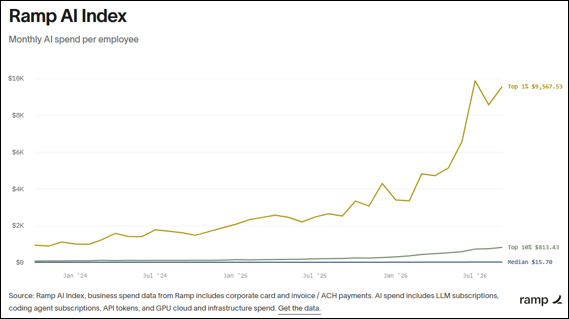
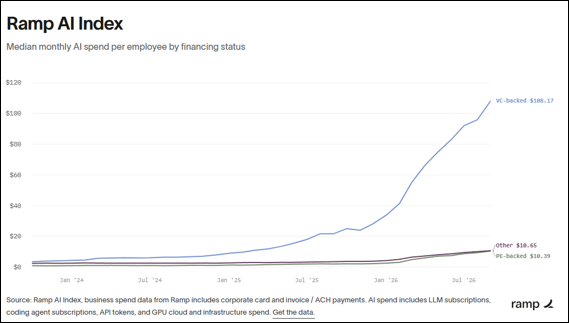
Perhaps equally concerning is industry-level data which show that VC-backed – typically pre-revenue and unprofitable – start-ups, are among the major customers of frontier AI lab models on a per capita basis. As per Ramp data, in Q3 2026, US-based, VC-backed firms’ median AI spend per employee was 10x that of a regular (and/or PE-backed) firm. Assuming that VC funding for frontier AI developers and top frontier AI consumers is adjacent, the risk of over-estimating demand due to circularity is compounded. Furthermore, Anthropic itself estimates that 5–7% of its sales in the first nine months of 2026 were generated by “distillation” attempts (p. 146 [A]) – i.e. rival (typically open-weight) model operators accessing Anthropic’s frontier models in an unauthorized manner, in order to develop/improve their own.
Continued, sustainable demand growth is thus no done deal, either for Anthropic or for frontier AI labs in general – though it is without doubt that AI adoption overall would continue. The economics of AI, however, might take a slightly different form than the highly-capital-intensive buildout we have seen thus far. In any case, Anthropic’s single-minded focus on deepening and broadening AI adoption is the correct strategy, though whether this results in profitable growth is our next topic.
No reliable insights yet into the margin economics of frontier AI
The cost structure of delivering frontier AI remains one of the murkiest aspects when analyzing the industry. Tokens are to AI what barrels are to crude oil: the essential unit connecting providers and consumers. Token cost and pricing (“tokenomics”) are thus the key questions in outlining marginal economics for both frontier and non-frontier AI. Irritatingly, the Anthropic filings do not shed much light on this subject, as the two breakdowns of operational expenses offered are not comprehensive enough to derive meaningful insights on fixed vs. variable costs, or clearly disentangle gross and operating profit. What the breakdowns do allow us to do is to catch a glimpse of what a complete margin analysis might look like.
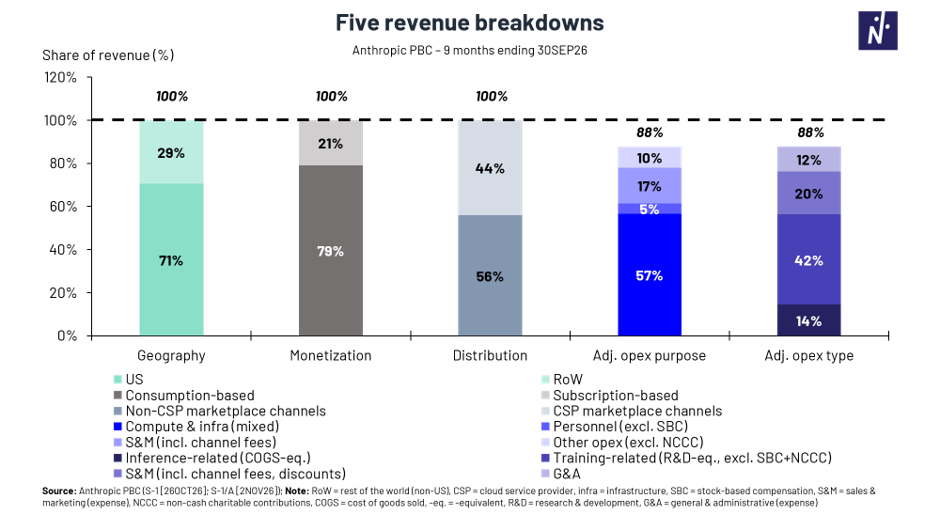
On the revenue-side, for the first nine months of 2026, we know this much about Anthropic’s revenue: ~70% US-based, ~80% consumption-based monetization, and ~45% generated via hyperscaler marketplaces. The preponderance of consumption-based monetization is a strong positive, given the inadequacy of subscriptions-based billing for variable frontier AI token consumption (which is expensive to deliver for the AI lab). The reliance on hyperscaler marketplaces shows on the adjusted opex-side, with ~17% of revenue attributable to hyperscaler revenue-share or distribution fees. If one adds discounts or promotions to customers, a further ~3% of revenue can be chalked up to S&M-related opex.
As mentioned, Anthropic discloses essentially two ways to break down its opex: according to either purpose or type (pp. F-7, F-39 [A]). What it identifies as closest to cost of revenue (or inference-related opex) is a mix of compute, infrastructure, personnel, and other costs which are directly related to delivering model outputs to customers. For this period, this inference “gross margin” is an impressive 86%. Meanwhile, training- or R&D-related opex (again, a mixed measure) shaves off 42% of revenue in opex. Interestingly, in its other breakdown of opex, all compute & infrastructure costs roughly equal the sum of training and inference – a strong indication of some consistency in how the firm identifies compute opex overall.
Given the strong interplay of training and inference in delivering its frontier AI services, it is hard to argue that a pure inference margin – even if accurate as presented – can double as a gross margin. If one would accept all compute/infra, personnel, and S&M (assumed to be mostly channel fees, and so COGS-like) as more representative of cost of revenue for a compute- and knowledge-intensive business, then our “gross margin” would be closer to a ~18%-21% range – with the adjusted operating margin just a tad below, around ~12%.
Beyond getting a glimpse of the current unit prices and costs of delivering frontier AI – as part of a snapshot in time – the evolution of marginal economics across time helps us understand whether efficiency and customer gains are permanent or temporary. The firm claims, in its S-1 filings, to have become significantly more efficient on an operating basis, citing the dollar value it generates in revenue per employee, as well as per dollar of compute/infra expense. It also notes that compute/infra expense growth has markedly slowed down compared to the growth rate of its revenue. These claims are prima facie accurate, with Anthropic able to show a ~>4x improvement in revenue delivered per dollar of compute expense between Q1 2025 and Q3 2026.
However, as the sales growth rate slowed down to 47% q/q in Q3 2026, compute/infra expense shot up to 77% q/q over the same time period, meaning Q2 2026 could be a local minimum for the share of compute/infra expense to revenue at about 48%, jumping to 58% again in Q3. Should these trends of higher compute/infra expense growth continue, alongside slowing sales growth, one can model multiple scenarios in which adjusted operating income turns negative again within a few quarters to one year. Worryingly, the bump in sales growth in the first two quarters of 2026 coincide with an explosion in S&M/partnership expense across the same two quarters, suggesting revenue might have been boosted by frontloading important customer discounts or a more favorable vendor revenue-share. The trillion-dollar question, therefore, is whether a local maximum in adjusted operating margin has already been reached mid-2026.
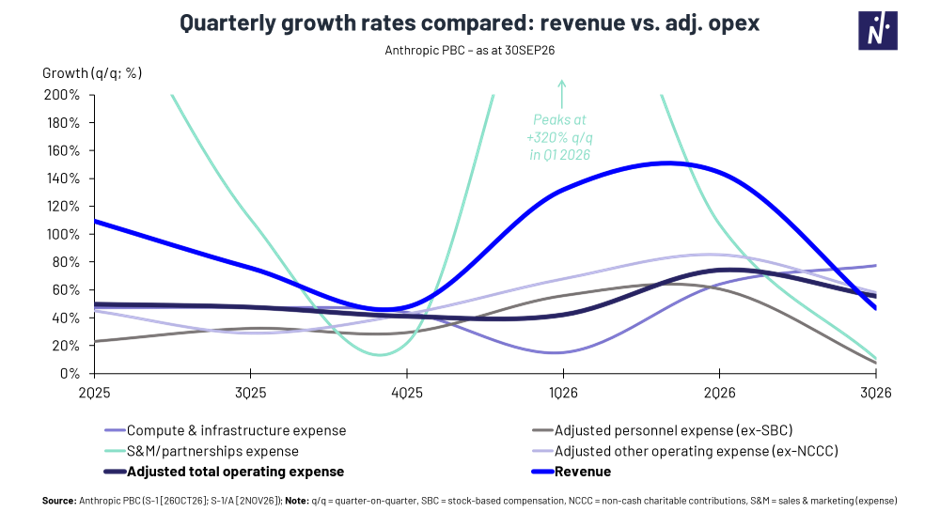
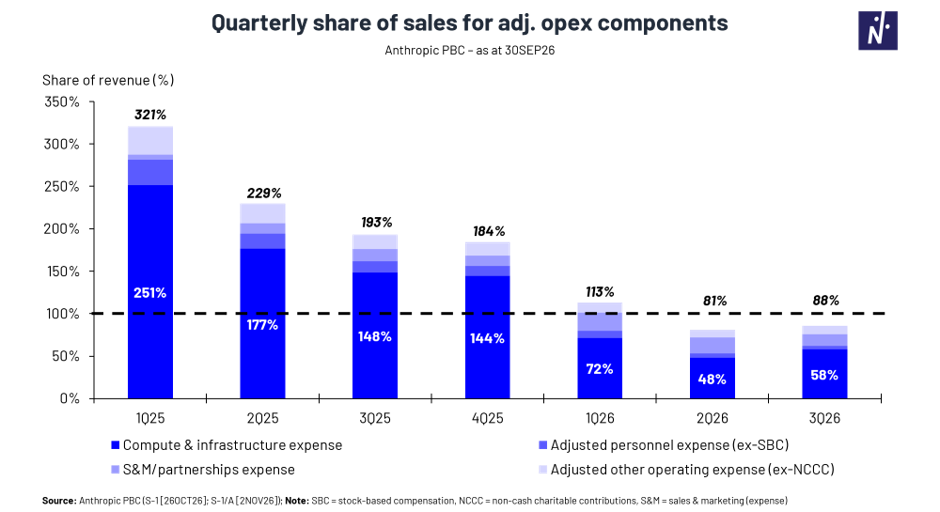
Ultimately, however, these discussions of marginal economics are only useful up to a point. Anthropic, much like its rival frontier AI lab OpenAI, has already planned its expense trajectory over the next decade, as we shall see immediately below.
Forward compute expense commitments are massive gamble on demand
Finally, laying at the intersection of demand and marginal economics, we turn to the most worrying aspect disclosed by Anthropic so far: its immense future spending commitments. Left blank in the original public S-1 filing, we now have the figure in the S-1/A: an estimated $895.39b in forward commitments (pp. 6, 33 [A]), most of it related to compute/infra expense. Of these, ~$106.80b are agreements entered into since 30 September 2026 (p. F-65 [A]). These figures might be underestimating true total forward obligations, given they reflect mostly minimum obligations, with variable cancellability, penalty, and contingency terms – not to mention some commitments may be undisclosed altogether (cf. pp. 173–176 [A]).
The firm agrees that this is perhaps the most disturbing aspect of its financial planning; in fact, it is the only explicitly financial issue addressed on the cover sheet of its Form S-1 (p. vii [A]) – a passage which deserves being quoted in full:
[...] Anthropic will often make forward investments (especially in compute) that may seem irresponsibly large at first glance. This derives from our belief, based on the scaling laws, that AI’s economic value is on an exponential curve and that the expected near-future economic value of our products will therefore be much larger than the current value. In order to fully capture the opportunity in front of us, we need to invest more aggressively than would a business that operates in a more slowly changing technological regime. [...]
Fair enough? Except for this enormous forward expense bill, frontier AI would indeed be a great asset-light business, relying on on-demand compute to both deliver inference and pursue training. However, to secure what the firm assesses as scarce compute, it is engaging in sizeable committed (or “forced”) opex – a huge portion of which, as we alluded to above, is non-cancellable. The firm further burnishes its rationale of compute scarcity with one of rising input costs for frontier AI (chips, power, and infra; see pp. 34–39, 164–165 [A]), which seems to be confirmed by industry commentary, such as reports by Citadel Securities (cf. GPU rental costs). It is the firm’s belief that front-loading such commitments may result in cost savings, compared to more ad hoc compute/infra commitments and/or reacting to short- to medium-term fluctuations in frontier AI demand.
To a large degree, the firm, much like its competitors, is right to plan ahead, particularly in the midst of a buildout which is indeed characterized by increasing scarcity for key inputs. Furthermore, its currently ample cash reserves, alongside its expected IPO proceeds (market commentary puts a base case around ~$80–90b in net cash inflows), and other measures to access liquidity and debt (see pp. 166–173 [A]) do give it some leeway to front-load immense expenses. This, in the end, and as discussed extensively above, hinges on exogenous demand materializing in a high-growth, sustainable, and profitable way.
If one breaks down the headline $895.39b figure into its component parts, the picture becomes somewhat clearer. We assume here that most of the spending commitments would ultimately show up as leases, or at least be expensed directly in the income statement (as opposed to being capitalized into PP&E) – as has been mostly the case so far for Anthropic. In this case, by noting or estimating the weighted average term of each lease or purchase commitment, we can come up with a back-of-the-envelope metric for how much Anthropic has committed to spend in annual compute/infra opex over the next few years. This yields an estimated ~$130b p.a. in “forced” opex (ignoring finer contractual points).
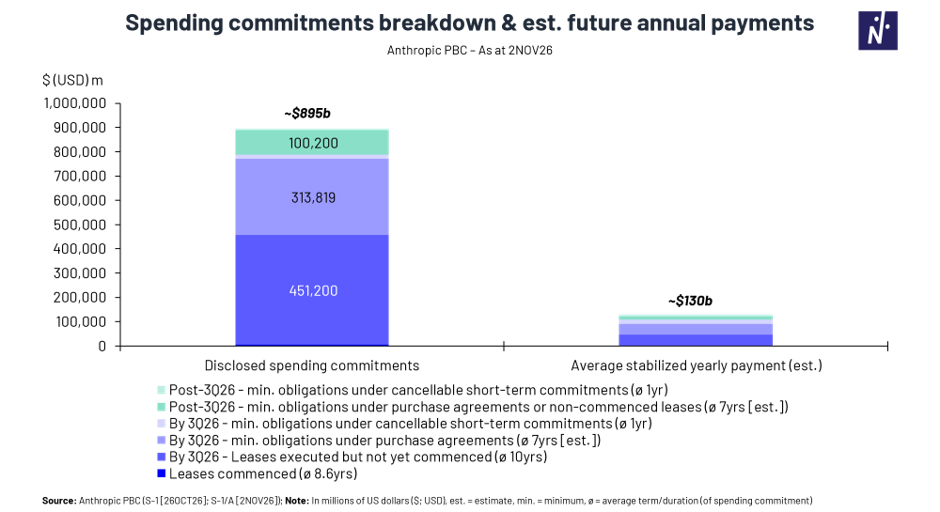
A lot of uncertainty surrounds these commitments, which are complex and diverse, even sometimes opaque or insufficiently described. It is unclear whether these represent the totality of what Anthropic deems necessary to deliver its frontier AI services over the next few years, or merely a fraction of the required expenses. Conversely, it is also relatively unclear which portion of these commitments could be scaled back in response to shortfalls in demand – or, put another way, what the firm expects its target, long-term, sustainable frontier AI gross margin to be.
If we run a simple simulation combining some of the elements we have discussed in this article – namely, revenue growth, other adjusted opex growth, estimated yearly committed compute/infra payments, net IPO proceeds, and cash balances – it becomes clear that, barring a super-charge in sales growth during the next few quarters, it is unlikely that Anthropic remain profitable on an adjusted basis over the short term. Many scenarios, however, could point to resilience in cash conservation – allowing revenue growth to finally overcome compute/infra expense growth once the spending commitments stabilize. Equity and debt capital markets, as well as bank lending, could also help pave over some of the rougher quarters. In this case, a path to resume adjusted operating profitability exists – even with the spending commitments disclosed above. Should the trends observed in Q3 2026 continue, however, the J-curve ahead then does look much steeper, and much more challenging without further equity financing. Perhaps, even, insurmountable.
Conclusion
Anthropic’s story, as told in its S-1 and S-1/A, encapsulates much of what is occurring as part of the buildout of frontier and non-frontier AI: mind-boggling growth rates; extreme fluctuations in demand, adoption, and pricing; massive front-loaded spending commitments amid record chip, power, and compute scarcity. We hope this article helped you better appreciate and digest this extraordinary moment in financial markets, business, and the wider economy.
Was this useful?
Let us know, or pass it along.Glossary
- AI
artificial intelligence
- COGS
cost of goods sold
- D&A
depreciation and amortization
- GPU
graphics processing unit (a key type of chip for AI training and inference)
- IPO
initial public offering
- J-curve
J-shaped curve which models a young firm’s lifecycle (profitability path)
- neocloud
non-hyperscaler cloud computing vendor, recently-founded, AI-focused
- neolab
recently-founded, typically pre-revenue, non-major AI lab
- PBC
public benefit corporation
- PE
private equity
- PP&E
property, plant, and equipment
- q/q
quarter-on-quarter
- R&D
research and development
- S-curve
S-shaped curve (flat-exponential-flat) which models new product adoption
- S&M
sales and marketing
- SAFEs
simple agreements for future equity (equity derivative-like securities)
- SEC
Securities & Exchange Commission (US)
- US
United States (of America)
- US GAAP
US Generally Accepted Accounting Principles
- VC
venture capital
- y/y
year-on-year
Sources
-
Anthropic PBC; Form S-1 Registration Statement (“S-1”), 26 October 2026, SEC EDGAR
-
Anthropic PBC; Amendment No. 1 to Form S-1 Registration Statement (“S-1/A”, or “[A]”), 2 November 2026, SEC EDGAR
-
Caughran, Brett; “Anthropic IPO Primer”, 26 October 2026, Fundamental Edge
-
Charles, Amelia & Arora, Harpreet; “Open weight takes 71.5% of tokens and 23% of spend (AI Gateway Production Index – October 2026)”, 15 October 2026, Vercel Blog
-
Damodaran, Aswath; “AI’s Bar Mitzvah Moment: From Hype & Hope to Business Questions!”, 20 August 2026, Musings on Markets
-
Damodaran, Aswath; “The Anthropic Prospectus Arrives: My (but not the) IPO valuation!”, 28 October 2026, Musings on Markets
-
Damodaran, Aswath; “The Anthropic Feedback Loop: The Cost of Capital Delusion and Diversion!”, 3 November 2026, Musings on Markets
-
Drehmann, Mathias & Eren, Egemen; “Building AI on credit: structures and spillovers”, 27 October 2026, Bank for International Settlements (BIS Bulletin No. 140)
-
The Economist; “Don’t expect supersize profits from Anthropic soon”, 26 October 2026
-
Flight, Frank; “Tokenomics 2.0”, 28 October 2026, Citadel Securities (News & Insights, Global Macro Strategy)
-
Frost, Jon et al.; “Circular relationships among AI firms”, 1 October 2026, Bank for International Settlements (BIS Bulletin No. 137)
-
FUNDA; “Research | ANT: S-1 Review and First-Cut EPS Model”, 27 October 2026, Substack
-
Kharazian, Ara; “Cracks in the AI Thesis Part 3”, 14 October 2026, Ramp Economics Lab
-
Lipschultz, Bailey et al.; “Anthropic Revenue Jumps to $16.8 Billion in Quarter Before IPO”, 15 October 2026, Bloomberg
-
Lipschultz, Bailey; “Anthropic Commits to $895 Billion in Spending as Mega-IPO Nears”, 2 November 2026, Bloomberg
-
Ramp Economics Lab; Ramp AI Index, accessed 6 November 2026
-
Reinicke, Carmen; “Anthropic IPO Filing Calms Nerves With Signs of Healthy Growth”, 27 October 2026, Bloomberg
-
Zitron, Edward B.; “Exit Liquidity”, 28 October 2026, Where’s Your Ed At?
-
Zitron, Edward B.; “Running Dry”, 3 November 2026, Where’s Your Ed At?