
2026-07-31 · Npercent Capital AG
H1 2026 in review and brief remarks on our deal flow
AI’s VC dominance: 80% of financing, 90% of exits, 100% of the attention.
Please kindly find below an edited version of the H1 2026 @Npercent Capital Markets in Review (early July 2026).
VC-relevant developments in liquid financial markets
Resilience: The continued investor enthusiasm (some may say “exuberance”) for expected AI sales growth and productivity gains proved crucial to listed equities’ resilience over the first half of 2026. Importantly, upwards revisions to earnings expectations drove global equities higher, with consensus now expecting nearly +28% earnings growth worldwide for the full year (revised up +11% in the second quarter alone). The bulk of earnings growth has, and is expected to be, driven by IT, the US, and emerging markets. Correspondingly, tech supply chain-heavy indices, such as Asia ex-Japan (overall: +33%; Korea: +88%; Taiwan: +49%), global small-caps (+17%), and global emerging markets (+24%) all outperformed the S&P 500 (+10%) in the first half of 2026.
Rotation: Resilient headline equity performance, however, belied rumblings below the surface, as investors increasingly favored IT sub-sectors such as semiconductors and hardware – which immediately benefit from the gargantuan AI capex cycle – as opposed to software and computing hyperscalers (incl. some of the famous “Magnificent 7”) – which are respectively either potential victims of AI obsolescence or excessive AI capex. Concerns about listed and unlisted software firms were particularly pronounced in the first half of the year (the so-called “SaaSpocalypse”), with knock-on effects on private credit and private equity vehicles. For instance, record redemption requests and gatings were registered at a wide range of “evergreen” (semi-liquid) private markets funds.
Concerns: Concerns about circular financing between unlisted AI labs (see below) and listed hyperscalers/chipmakers also gave investors some pause, with creative sales/earnings accounting becoming a serious possibility. The continuation of the AI boom by other means – that is, credit – also fuelled investor concerns. Shockingly, however, corporate credit spreads remained tight while the US tech giants carried out colossal multi-currency new bond issuance, totalling ~$327b since the beginning of the year. Amazon.com, Alphabet, Meta, Oracle, NVIDIA, and the newly-listed SpaceX and CoreWeave were particularly active in credit markets. This credit splurge is helping fuel the historical AI rollout beyond the capacity and appetite of listed and private equity markets. The scale of the AI rollout has meant expected capex from US hyperscalers are now pegged at ~$715b for 2026, worryingly turning the internet titans’ expected aggregate free cash flow negative – a drastic contrast with yesteryear.
Crypto: Finally, bitcoin continued its long price decline (ongoing since Q3 2025), despite increasing institutionalization – down nearly -32% over H1 2026, and hovering near $60k/BTC. It is likely a victim, alongside the broader original crypto space, of the competition with AI for speculative investor flows, and with stablecoins/CDBCs for decentralized finance (DeFi) usage.
Illiquid markets and VC (venture capital) industry developments
Headlines: Global VC financing for the first half of 2026 has already beaten the whole of 2025, with $560.4 billion invested (vs. ~$510b for 2025) – and already making it by default the third-best year ever for the industry, according to PitchBook. These deployments were spread over ~18.4k deals so far – continuing an overall trend of declining deal counts (and increasing deal concentration). Furthermore, AI-related investments represented an astonishing ~77% of all deal value – though their share of deal count was relatively stable, representing around a third of all deals. Finally, and quite importantly, this was also the half-year of the big VC exit comeback, with the highest exit value ever recorded: an incredible ~$2.34 trillion, split into ~$1.89 trillion via IPOs, ~$0.41 trillion via M&A, and the remainder in buyouts. The first half probably sets the tone for the rest of the year: extreme AI volumes and concentration in both funding and exits. Interestingly, the intense deal-making did not necessarily translate into a strong replenishing of VC fund “dry powder”, with 2026 forecast by PitchBook to have the weakest new VC fund count in at least 10 years.
All-time fundraising records: Looking at financing deals in detail: the top VC round of the half-year (and, coincidentally, of all time), was AI lab OpenAI’s $122b Series F, which valued it at $852b post-money (closed March 2026, co-led by SoftBank and other strategic partners). Not to be outdone, its arch-rival Anthropic raised thrice in the first half of 2026: once in January (Series F, $10b on $350b post-money, co-led by Singapore’s GIC and VC Coatue), once in February (Series G, $30b on $380b post-money, follow-ons supplemented by the likes of Abu Dhabi’s MGX and Qatar’s QIA), and once more in April (Series H, $65b on $965 post-money, co-led by a number of participants). Incidentally, Anthropic’s Series H and Series G were the second- and third-biggest VC funding rounds ever – which means the top 3 VC funding rounds of all time all occurred in the last half-year.
Rivals: The intensifying rivalry between the two leading AI labs was most evident in April, when uncorroborated financial reporting was released showing Anthropic was surpassing rival OpenAI in annual recurring revenue (ARR) – Anthropic also claimed in May that its adjusted operating profit would also briefly turn positive in Q2 2026, though this is also unproven. Both labs are racing to IPO at or above $1 trillion valuations, presumably in the second half of the year or early 2027, and have accordingly confidentially filed with the US SEC.
Other raises: Elsewhere, AI lab and social media platform operator xAI also raised $20b in January (Series E, $230b post-money), while Alphabet’s ride-share/robotaxi platform Waymo raised $16b in February (Series D, $126b post-money). Other noteworthy financing rounds included Jeff Bezos’ Prometheus (physical AI, Series B, $12b on $41b post-money), and China’s DeepSeek (AI lab, Series A, ~$7.4b on ~$50b post-money). Altogether, the Big Four AI labs’ share of overall VC funding alone was – again – an astonishing 47% of all VC fundraising in H1 2026.
SpaceX IPO: Meanwhile, VC exits in the first half were co-dominated by spacetech and – unsurprisingly – AI. SpaceX’s IPO was the first test of investor appetite and capacity for what are presumed to be more megacap IPOs to come over the next 12 months. On 12 June 2026, SpaceX carried out the largest IPO in history, raising $75b at a $135 price per share, implying a ~$1.77 trillion market valuation – making it the seventh-to-eighth largest publicly-listed firm in the world by market capitalization. The now-listed shares subsequently peaked above $200 around a week later, with the firm briefly valued above $2t – but they sat at around ~$153 as of the end of H1 2026. SpaceX’s valuation will be tested further as various lock-up expiries loom, with the stock poised to achieve nearly-100% free-float status in the second half of 2027.
SpaceX M&A/credit: Importantly, SpaceX had laid the groundwork for a combined spacetech and AI exposure in February, when it acquired xAI – another Elon Musk company – in a $250b all-stock transaction. SpaceX wasted no time utilizing its newly-listed status, carrying out further M&A by acquiring Anysphere (the parent of AI coding start-up Cursor) for $65b in another all-stock transaction less than a week after its IPO, and coming to the investment-grade bond markets with a $25b multi-tranche offering in late June. SpaceX’s activities alone represented 89% of all the VC exit value recorded in H1 2026.
Other IPOs: Other notable IPOs in the first half included: AI-focused chipmaker Cerebras Systems (raised $5.55b @ $185 per share, implying a ~$56.4b market valuation) and quantum computing firm Quantinuum (raised $1.68b @ $60 per share, implying a ~$15.7b market valuation). Korean memory chipmaker SK Hynix also offered ADRs on 10 July 2026, flirting with the $1 trillion market cap club – though that is outside our review period. As a side-note, Alphabet’s $32b all-cash acquisition of cybersec firm Wiz closed in March, one year after its announcement.
Swiss VC – 2025 headlines: Closer to home, in Swiss VC: with full-year domestic data for 2025 now available, we can mostly confirm the trends identified in the first half of 2025. Last year did end up being the third-best year ever for domestic VC funding (after 2021–22), with ~CHF2.95b invested, across a stable amount of deals (~350). A large part of the funding strength came from continued momentum in biotech (32% share of total deal value), but especially from the extremely-strong rebound in ICT funding (26% share), relative to 2024 (+145% y/y increase). ICT also captured most of the deal count, with nearly ~120 deals, while fintech and cleantech registered strong reversals in that metric.
Swiss VC – 2025 details: In terms of lifecycle stages, deal volumes in later stages were stable, while seed (+24% y/y) and early (+73% y/y) experienced stronger growth – underlining the renewed enthusiasm in biotech, and the more recent appetite for AI and robotics. By contrast, exit dynamics remained weak in 2025, though expectations were clearly higher for 2026. On the cantonal level, ZH, VD, and BS remained the dominant start-up hubs, with BS experiencing record funding. The top 3 funding rounds of the year were: Windward Bio (BS, immunology, Series A, May 2025, $200m raised on undisclosed valuation), Climeworks (ZH, carbon capture, Series E, Jul. 2025, $162m raised on undiscl.), and Distalmotion (VD, robosurgery, Series G, Nov. 2025, $150m raised on undiscl.).
Swiss VC – First half 2026 preview: According to preliminary data, the first half of 2026 showed some deceleration in overall investing activity, down roughly -15% compared to the previous comparable half-year (H1 2025). Additionally, hardware outperformed (+937%) both ICT (-57%) and biotech (-74%), which saw year-on-year declines. Cleantech also rebounded (+231%), alongside healthcare IT (+326%). Furthermore, ZH experienced a strong drop in investment activity – its lowest level since 2018 – while VD, ZG, and SZ shone. Finally, exit dynamics, despite high expectations, remained subdued – despite encouraging signs from increasing strategic investments. Valuation and exit expectations, correspondingly, are high for the next 12 months.
Brief remarks on our observed deal flow
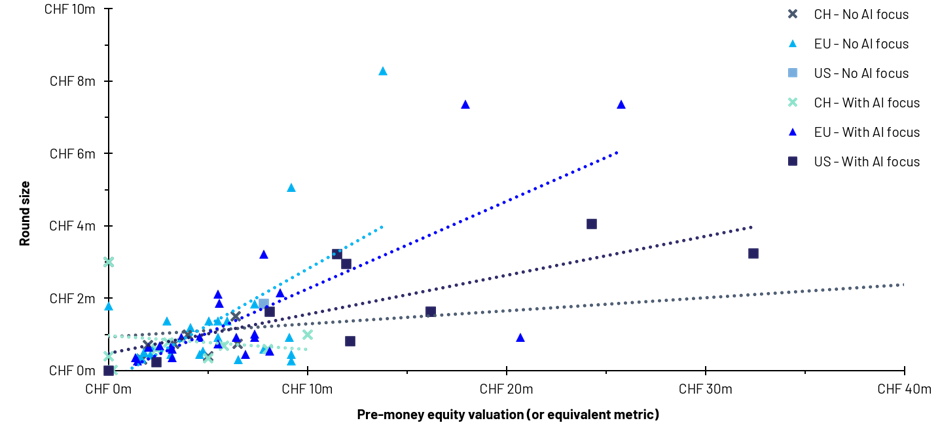
Patterns in financial and other data can be extremely revealing, particularly as far as “value for money” is concerned. Throughout the first half of 2026, the whole of 2025, and for punctual data points before then, we have been collecting information on our observed deal flow, representing roughly ~75 separate deals – which we are now happy to present to you visually:
Chart 1: Plotting pre-money valuations vs. round size, according to geographical and AI exposures
Source: Npercent Capital AG; Note: Assumed FX rates: EUR/CHF = 0.92, USD/CHF = 0.81, GBP/CHF = 1.08
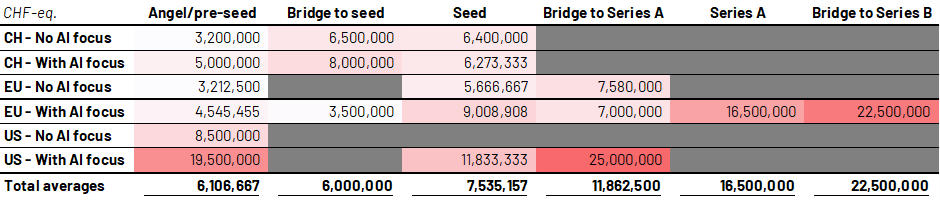
Table 1: Average pre-money valuations across financing stages, according to geographical and AI exposures
Source: Npercent Capital AG
An analysis of our ~75-deal dataset – which, being composed of relatively anecdotal data points, can lead to no firm conclusion – does confirm some of our key impressions: (a) the clear valuation premium (overvaluation?) attributed to AI-focused ventures, and (b) the richness of valuations commanded by Swiss and American ventures (particularly the latter) over European ones, and this at all lifecycle stages (see Table 1 above). If one examines the linear trendlines across the categories examined in Chart 1, one may make some observations: the flatter the slope, the less willing founders are to give up higher shares of their business as their pre-money valuations increase. Quite fittingly, the linear trendlines are flattest for both relevant US and Swiss firm categories, and less flat for their European equivalents – implying stronger founder pricing power over VC investors in America and Switzerland, compared to Europe. Our limited dataset is thus compelling enough for us to speculate that, yes, Europe indeed holds better “value for money”.
Sources
-
J.P. Morgan Asset Management, Review of markets over the second quarter of 2026
-
Idem, Guide to the Markets (GTM) EMEA 3Q 2026
-
Idem, Eye on the Market: Semiquincententacles
-
Idem, Mid-Year Investment Outlook 2026: Enough fuel in the engine
-
Deutsche Bank Research Institute, Charts to make you go WOW!!! 2026
-
Bank for International Settlements (BIS), Annual Economic Report (June 2026)
-
PitchBook, Global VC First Look Q2 2026
-
Idem, The Global VC Multiverse
-
Crunchbase, Global Startup Investment Hit Record $510B in H1 2026 [...]
-
startupticker.ch & SECA, Swiss Venture Capital Report 2026 (and associated slide deck)
-
Idem, Swiss Venture Capital Report 2026 – Update